Would you like to deepen your skills and knowledge in signal intelligence, spectrum monitoring, and related software and hardware evaluation? Our training courses deliver the background knowledge and hands‑on expertise that go far beyond what you will find in any manual. We focus on real‑world scenarios and are ready to address your specific questions directly.
Key Facts
Training language: English (or via interpreter)
Improve efficiency and save valuable time
Enhance employee performance and boost productivity
Direct access to the latest knowledge from instructors who work with these tools every day
Due to software complexity, not all functions are documented—learn features and workflows directly from experts
Training includes recorded signals, live signals, and user‑provided files
Recommended maximum group size: 8 participants
Duration: 6 hours per day (or 3 hours/day for webinars)Training certificates issued for each participant
Documentation provided: PDF materials and original manualspy
DDL & go2ANALYSE training is exclusively offered by PROCITEC
Special Setups
We are in the position to provide you also some modified schedules like
2 days go2MONITOR and 2 days go2DECODE
1 day go2MONITOR and 2 days go2DECODE
2 days go2MONITOR and 2 days practical work
...
Webinars
We offer our training webinars worldwide. Webinars are easy to set up and require no travel, making them a highly efficient alternative to on‑site training. However, they also come with limitations: direct eye contact is missing, and in‑depth discussions can be more challenging to manage in an online environment. On the customer side, a stable internet connection and suitable audio/video equipment are essential to ensure a smooth training experience.
Additional Background Knowledge from shoc
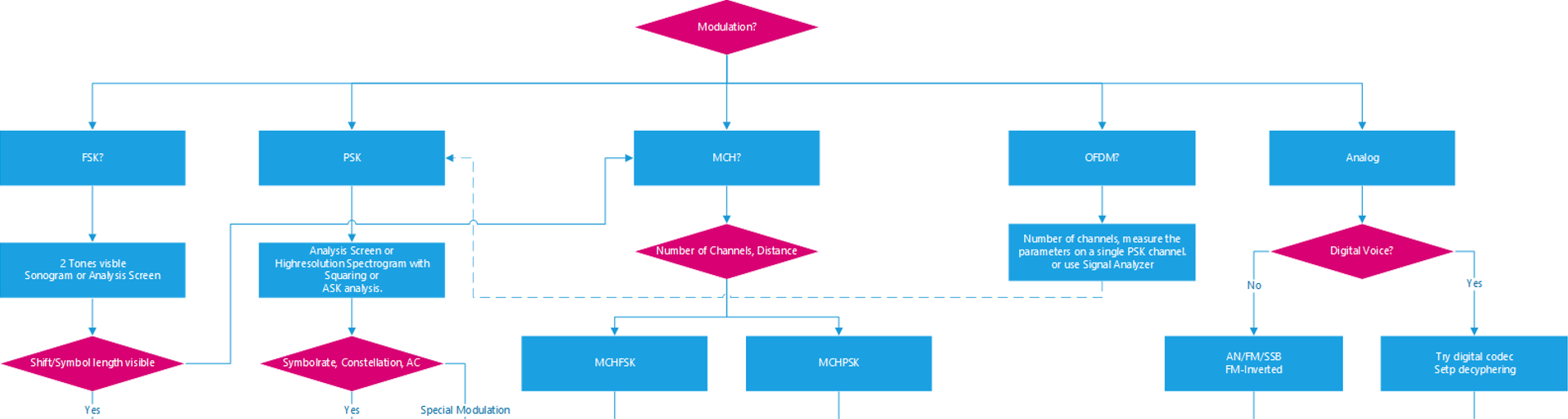
In our training courses, we provide additional knowledge and practical tools, such as this decision tree for manual signal analysis (the graphic shows only a small excerpt of the complete version).
shoc COMINT Basic Training
Focus
The course provides new operators with an overview of various COMINT software packages and the necessary hardware and software.
EW Definitions, COMINT, SIGINT
Modulations
Decoders
Receivers, Antennas, DF
Objectives
After the training, participants will be have a basic know-how about the most common signals and learn how to operate and setup antennas, receivers and decoders.
Signal Analysis, Constellation, Eye-diagram Auto correlation, etc
FSK Signals
PSK Signals
Customer Recordings
4. Day - Live Monitoring, System
MFSK/MPSK Signals
VHF/UHF Decoders
Bit Analysis, Decoder Development
Using Python for analysis and evaluation
Scheduling, Planer, Alerts
Remote
Big Data
Q & A
Duration
4 days
Implementation
Customer premises
Webinar
shoc go2monitor Training
Focus
The course covers the basics and capabilities of go2MONITOR with the options for:
Automatic Monitoring and Tasking (AMT)
Narrowband Receiver Control (NRC)
Wideband Recording (WBR)
Wideband Classification (WCL)
Wideband Multi Production Channel (WMPC).
Objectives
After the training, participants will be able to understand the functions, the results and handling of the system, and will acquire basic skills in defining jobs and evaluating results of the system in manual and automatic mode. They will be able to setup receivers and write short scripts.
Target audience
Operators
Supervisor
Knowledge required
The participant should have basic skills in communication technology
For scripting, experience in PYTHON will be helpful.
2-4 days, the longer training is recommended for complex setups with many options
Implementation
Customer premises
Webinar
Comments
2 days for experienced users or operators that moved from HOKA, WAVECOM or Krypto500/1000 to go2MONITOR
4 days for beginners
shoc go2modem-studio & go2signal-analyzer (go2DECODE) Training
Focus
The training course includes a detailed presentation of the components go2modem-studio (without Decoder Development, pyDDL) and go2signal-analyzer. Alternatively, the course can also be held as go2DECODE training.
The basic analysis steps are illustrated using many practical examples. In addition, participants will verify their understanding of signal analysis, demodulators and decoders by practicing with various types of recorded signals. Part of the time will be reserved for discussing individual tasks and problems as well as analyzing signals provided by the participants.
Objectives
After the training, participants will be able to understand the functions and handling of go2modem-studio & go2signal-anylzer, and will acquire basic skills in analyzing modulated signals and creating suitable modems for manual or automatic signal detection and production. pyDDL is not coverd in this training.
Target Audience
Operators
Analysts and supervisors
Knowledge required
The participant should be familiar with fundamentals of communication technology.
Contents
General software introduction
Fundamentals of digital signal modulation
User interface overview
Signal interfacing and adjustments
Rapid pre-classification of modulation types
Analyzing signals
Setting up demodulators
Analysis of demodulation results
Setting up modems and modem lists
Automatic production and signal recording
General training with recorded signals
Brief introduction to Decoder Description Language (DDL/pyDDL)
Special questions and individual tasks
Duration
4 days or 5 days
Implementation
Customer premises
Webinar
go2signal-analyzer Training
Focus
The course focuses on developing participants' knowledge of signal analysis techniques and procedures using the go2SIGNAL signal analyzer. During the training, participants' skills are developed through practical “real-world” exercises using live signal recordings from PROCITEC and, optionally, recordings made by the participants themselves.
Objectives
After completing the training, participants will understand the functions and capabilities of the go2signal-analyzer software and will have acquired knowledge in the analysis of unknown modulated signals.
Target Audience
Signals Analysts
Technical staff involved in writing, modifying and editing decoders
Knowledge required
The participant should have a good understanding of the RF spectrum and signaling techniques
Contents
General application introduction
Fundamentals of digital signal modulation
Rapid Pre-Classification of unknown signals
Analysis of FSK, MFSK, PSK, MSK, OQPSK and OFDM signals
Duration
3 days
Implementation
Customer premises
Webinar
Secrets...
The real secret of effective training is this: Practice. Then practice again… and again. Repetition builds confidence and mastery. And always remember: begin with small steps.